UNLEASHED, UNCUT, UNREAD


Showing posts with label fauna. Show all posts

5.22.2007

4 notes

1. Those subway and sewer vents in downtown are veritable chasms whispering my siren song. I'm not convinced that I won't plummet to my demise some day walking over those evil grates but I'll be damned if i'm not gonna risk it. I've observed the plight of my chewing gum and it's not pretty. But that's why I carry around my Mary Poppins umbrella. Well, one of the reasons I carry around my Mary Poppins umbrella.
2. The NBA playoffs are no longer my friend. I had three teams that I was really excited about watching. All three lost last round. Not only that, they either played half-ass or suffered the pangs and arrows of outrageous officiating. The only thing I can fall back on now are my childhood sweethearts, the Utah Jazz, which captivated every soon-to-be-five-eleven-white-kid-from-spokane-washington back in the day. But Mr. Stockton and his crew broke my heart too many times in adolescence for me to lightly dig those pompoms out of storage.
3. I swallowed a bug while running today. That little bastard bee-lined straight for my non-existent tonsils and fulfilled his kamikaze pledge. Although I'm not convinced that dying in a violent phlegm tornado is really that honorable, I must commend him on his aim.
4. I didn't really have a fourth point. But, damn, the first three were really good. Really, really good.

10.05.2005

Aim for the stars, man, but c'mon!

Continuing the theme of the week, which vaguely entails animals acting in strikingly anthromophic ways (weapon-happy/vengeful/idiotic), here's a couple choice excerpts from the latest find:

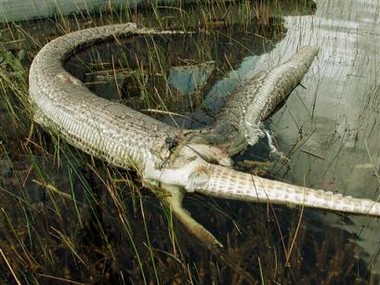
A 13-foot Burmese python recently burst after it apparently tried to swallow a live, six-foot alligator whole, authorities said.
The incident has heightened biologists' fears that the nonnative snakes could threaten a host of other animal species in the Everglades....

...The snake was found with the gator's hindquarters protruding from its midsection. Mazzotti said the alligator may have clawed at the python's stomach as the snake tried to digest it.
In previous incidents, the alligator won or the battle was an apparent draw.
An alligator, it swallowed a six-foot long alligator...that was alive! I think natural selection is having its way one moronic python at a time.

Maybe it happened, maybe it didn't....

...your call:

STOCKHOLM (Reuters) - A Swedish hunter was knocked unconscious after his son shot a flying Canadian goose which then fell onto his head, news agency TT reported Wednesday.

"I guess it wanted revenge," hunter Ulf Ilback told local newspaper Extra Ostergotland, according to TT.

Ilback said he had to stay in bed for two days after being knocked out by the goose, which fell from around 60 feet. The birds can weigh up 13 pounds.

10.03.2005

Austin Powers realized

1. Dr. Evil:

You know, I have one simple request. And that is to have sharks with frickin' laser beams attached to their heads! Now evidently my cycloptic colleague informs me that that cannot be done. Ah, would you remind me what I pay you people for, honestly? Throw me a bone here!
2. Excerpt from this absurdly, stupefyingly, bewilderingly ridiculous story:
Experts who have studied the US navy's cetacean training exercises claim the 36 mammals could be carrying 'toxic dart' guns. Divers and surfers risk attack, they claim, from a species considered to be among the planet's smartest. The US navy admits it has been training dolphins for military purposes, but has refused to confirm that any are missing.

Dolphins have been trained in attack-and-kill missions since the Cold War. The US Atlantic bottlenose dolphins have apparently been taught to shoot terrorists attacking military vessels. Their coastal compound was breached during the storm, sweeping them out to sea. But those who have studied the controversial use of dolphins in the US defence programme claim it is vital they are caught quickly.
Those English people and their wild imaginations.

K-research Laboratories contributed to concocting this story.

9.15.2005

You can't run away (from problems) on a treadmill

Although you’re more likely to encounter most of the animals in the Anchorage zoo while cross-country skiing down one of the city’s urban trails, a few key exceptions to this rule reside in those pens. Most notably, the zoo has remained defiant through much controversy and maintained their 23 year old African elephant, Maggie.

This decision sickens me for all the reasons it sickens everyone else.

I arrived in Anchorage in the middle of January-halfway through their winter. By the time the ice and snow retreated enough to spend a considerable amount of time outside without warm clothes and equipment, I was getting stir crazy. That occurred in May. I’m not kidding, it was May. Relative to much of Alaska, Anchorage lies to the south and experiences the mellowing influences of coastal weather. However, let’s underscore the fact that it gets brutally cold up there and legitimate winter weather spans roughly six months (according to my sister and brother-in-law who live up there, it’s been pouring rain and hovering in the 40’s and 50’s for weeks now…it’s only September). Regarding my struggles with the weather, I wasn’t exactly living in the tropics, or even California, prior to moving there. So, although the climate shift proved substantial, it wasn’t as significant as might be experienced by someone or something moving from, ohhhh, let’s say the Sahara.

But guess what? Maggie belongs in the Sahara. Her genes didn’t arm her with the defenses necessary to combat harsh temperatures, cold winds, snow and sleet. Nor does any of the vegetation she’s used to stand a chance of growing up there.

Furthermore, as mentioned in the article, elephants herd together. Maggie, however, had one companion up until 1997 and has since spent her days among alone or among humans. Not only would this significantly alter her natural behavior (which constitutes one of the fundamental reasons for building zoos-to educate people about how animals act in the wild) but probably inflicts psychological distress in the form of loneliness and depression.

I write about this today because the zoo announced they purchased parts to construct a 16,000 pound treadmill upon which Maggie can exercise during the protracted northern winters. This extravagant gesture will do little to quell the storm of controversy surrounding the zoo’s decision to house and keep Maggie. Instead, it seems this costly and untested device serves to buy the zoo more time while they persist in mistreating this natural treasure for their own benefit.

Normally, I get a kick out of reading through the Oddly Enough news section because most of the wacky stories provide harmless, head-shaking anecdotes about ridiculous people. This story just pisses me off. I’m not the first to call for Maggie’s removal from the zoo, but it bothered me while I lived up there and it still does today. The Anchorage Zoo needs to acknowledge their inability to properly house this animal, regardless of the elaborate contraptions they devise. Maggie should not spend another winter in Alaska.

9.09.2005

Drawing an important, but difficult line

One of the projects I’m participating in at the National Academies seeks to determine the extent of Ecosystem impact due to fishing and make recommendations about halting or reversing the damage. This has proven an interesting and complicated topic for a number of reasons.

For one thing, the volume of our global oceans dwarfs any scale we typically discuss, which makes it incredibly difficult to gather the requisite data. The five oceans (yes, 5…in 2000 the International Hydrographic Organization denoted the Southern Ocean which surrounds Antarctica and extends to 60 degrees latitude) cover 70% of the earth’s surface and dive to depths of over 36,000 feet. That’s an unimaginably vast region to monitor. Although satellites, an international fleet of research vessels, and unmanned buoys distributed in all corners of the globe constantly process information, it’s not even close to enough.

Then there’s the problem with data we do collect. Available information focuses on a few lucrative target species that can be gauged relatively accurately. Although this data seems mostly reliable, the preponderance of the information comes from the fisheries themselves, which presents the possibility of bias (although fisheries argue somewhat convincingly that they have an invested interest in maintaining a robust stock more than anyone, hence, why would they distort numbers to increase fish abundance). Regardless, these condition of these key fish stocks are known pretty well.

The impact on subspecies, non-target peripheral species, and non-fish marine life remains largely unknown, however. This occurs in a couple ways. For instance, the enormous nets used by commercial and industrial fisheries aren’t selective about which species they sweep up. Therefore, although a trawler in Northern California might only gather fish in an area known for high rockfish concentration, that doesn’t mean the rockfish will always swim there and it doesn’t mean the rockfish will exclusively swim there. Inevitably, many undesired lifeforms meet their demise in a confused tangle of net. Some choke themselves or slit their own throats on the netting, others are eaten in the melee, still others manage to escape but leave behind a crucial fin or an eye, thus leaving them prostrate to the brutal Darwinian forces operating in the seas. Those that don’t die on the boat are thrown back in an often mortally weakened state that basically guaruntees their imminent end. All these species perish to nobody’s benefit and most of them are not accounted for.

Beyond that, although the fish might escape the net, their habitat might not. Imperiled coral reefs, mangrove forests, and sediment beds constitute just a fraction of the habitat damage inflicted by these nets. Do you really think the fish will survive without that vital protection?

Then, there’s the clutter left behind: oil, nets, boats, ropes, pulleys, aluminum cans, drums, etc. etc.

Now, consider the cascading effect of severely diminishing one top-tier predator from the oceans. Blue marlin and swordfish, for example, once thrived in the central north Pacific, but their numbers plummeted in the second half of the 20th century. This allowed the small tuna population, the prey of those larger predators, to thrive. If given sunlight, the grass will grow. Or perhaps a fish species disappears the fed off the microscopic life at the ocean’s surface. Algae thrives, maybe to the point of taking over vast areas.

So does this constitute ‘damage’ to the ocean’s ecosystem, or is this just humans playing their role in evolution and natural selection. Sure, we kill off one species, but that means something else thrives. How do we decide if we should stop or even reverse an ecosystem (given the dubious argument that it is possible) and if so, to what former point on the temporal scale will be determine the pristine, wilderness ocean? If we do condone human invasion of the seas to gather nourishment where do we establish the cut-off point for such intervention and manipulation?

I don’t count myself among those promoting a complete withdrawal from the seas. I’ve fished before and I will happily fish again. My personal philosophy is that humans are another type of animal that uses primarily intellectual and technical ingenuity to subsist, rather than physical ability. Either way, we still need to consume to survive, just like any other animal. In reality, the gigantic net is only an extension of the spear. The exception, of course, being that the spear doesn’t kill things it doesn’t intend to kill. I think if you fish, then you should eat what you catch. I’d say the same about hunting. Therefore, I look forward to the advent of techniques that allow targeted fish, and only targeted fish, to be caught in humane ways.

By diversifying our diets and avoiding unnecessary and inhumane kills, I think we can move closer to impacting the ecosystem less while remaining realistic about the fact that we are member-crucial members-of this global community and will invariably leave our mark. We adjust to what we know, and if more types of cuisine passed down our throat, we’d realize there’s no reason to concentrate on just a few. This ensures that no species diminishes to the point of extinction. The important thing is that the consumer ultimately drives the market. If you disagree with the harvesting of a particular type of species, don’t eat it. If you think others should do the same, offer a convincing argument defending your position. Screaming at somebody won’t do the trick.

Lest this entry turn into a novel and cheap proselytizing, somebody put a muzzle on me. I’m running away to the wilds of Virginia for the weekend, so fare ye well. (ps. i wrote this kinda fast and gotta cruise so i apologize for any glaring grammatical mistakes, missed words, etc....also, as always, i apologize for myself in general)

8.25.2005

Update from the blood-sucking leech front

The Times caught wind of my blog entry exploring the medicinal use of leeches and decided to pursue the issue further. Here's an article they published today describing how a federal board of medical advisers is currently meeting to decide how best to regulate leeches, maggots, and other repulsive, yet useful medical 'devices'. really though, i still don't like 'em. (Compliments of Kresearch laboratories)

8.05.2005

Why didn't South Korea choose him?

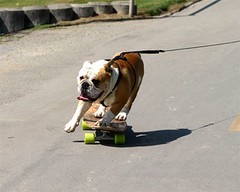
What animal could possibly be more deserving of having its genes duplicated than my new-found friend Tyson? Suggesting my girlfriend's current level of productivity at her job, she managed to find this genius bulldog who conducts himself with infinitely more poise and style on a skateboard than I ever have or will. Be sure to check out the video clips listed under 'Pics and Movies' because they'll blow you away, especially the one where he's riding downhill towards the beach. Ty and Eric, you better be down at Huntington Beach on September 18th, because Tyson will reign as Grand Marshall during Walk For The Animals. I'll never forgive you if you don't go.

Also, while doing my research to verify that i'm not the only idiot utterly captivated by this dog, I happened upon another website listed in Men's Journal's 100 Best Websites from August 2004 that consists of videos showing scantily clad, voluptuous women trying to rev their sporty rides out of various muddy traps. My unschooled opinion thinks they're catering to those with foot fetishes, mudwrestling afficionados, and control freaks, but i'm probably wrong. Imagine sitting-in on the think tank that engendered this marvelous creation. I wonder if they considered the equally tantalizing 'womensharpeningpencils.com' or 'babesbreathingoxygen.com'?

It takes all kinds.

Oh yeah, why are they trying to rename my street. Reagan already has his airport and federal building, isn't that enough. Story first broken by DCist.

7.29.2005

I can palm a wrecking ball

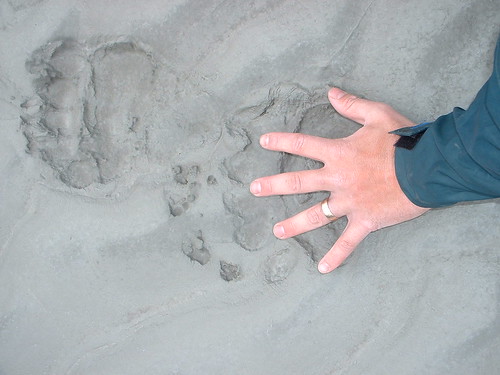
Here's a picture of my brother-in-law's hand on top of a grizzly bear's pawprint in Alaska. Jeff proceeded to hunt down the animal and inflict mortal wounds with a boomerang.

7.26.2005

Diversions, great and small

I went and saw March of the Penguins last night. It’s one of those movies that’s so endearing it’s almost nauseating at times. The movie traces the breeding ritual of Emperor Penguins in the inhospitable ice-world of Antarctica. Among the wacky things of note are a treacherous march to the interior ice fields, riotous mating dances, the absurdity of monogamous breeding, penguin chicks sticking their little beaks up their parents’ throats to ingest regurgitated food and the single-minded obsession with protecting a fragile life in -80F temperatures with winds topping 100mph. It’s almost impossible to keep anthropomorphic projections out of your psyche and remember that your watching birds. Some don’t make it, and you feel human emotions course through in response. It’s crazy. The thing is that anybody can tell you about this, but it only really hits home when you take in the visual feast yourself. If nothing else, the alien Antarctic landscape and the thought of filming under such punishing circumstances should be enough to captivate your attention for 90 minutes. I highly recommend anyone with a pulsating heart and the ability to imagine the unlikelihood of a polar bird’s existence to see this movie.

Also, I checked out Charlie and the Chocolate Factory last week. Stop reading if you don’t want to hear what I have to say. Okay, for those still on board. I was disappointed with the movie. I fully expected Tim Burton to take his usual artistic liberties and play with the original, but I expected him to do it successfully. He didn’t, in my opinion. The imagery that captivated in the original was still there, but in many cases it was almost exactly reproduced, not very developed or evolved. What irked me most, though, was Burton’s treatment of Willy Wonka himself. I find it hard to imagine a character more befitting of Tim Burton’s treatment than Willy Wonka. The complexity, depth, and idiosyncrasy of Wonka (brilliantly played by Gene Wilder in the original) practically begs for Burton to let his fingers dance with those puppet strings and create something beautifully weird. In truth, Burton could have cut the strings and let Johnny Depp take over. Unfortunately, Depp didn’t even get a chance because the script wouldn’t allow it. Instead, Wonka hardly even materialized as a multi-dimensional character and emanated disturbing hints of Michael Jackson in a purple suit. I’m far from ideologically opposed to remakes, especially when the new breath has a touch of mischief/ bizarreness. Burton’s Wonka, however, doesn’t even come close to the original that included an epic score, a much better ending, and an unforgettable Wonka.

7.21.2005

I still don't like 'em

There's people out there doing crazy things. I read an article in this week's New Yorker (article not yet available electronically) that delved into the esoteric world of leech research. Some highlights follow:

  • Leeches have 3 jaws arranged in a Y-shaped pattern, each of which contains about 100 teeth. After latching onto the flesh-o-the-day (actually, they feed much less frequently…some leeches can live up to a year between meals), they penetrate skin by sawing through with their miniscule teeth.
  • There are 4 commercial leech farms in the world, one in each of the following countries: England, France, Germany, and Russia.
  • In 2004, the FDA authorized leeches for use as medical devices. Leeches can play a crucial role in microsurgery, such as helping to reattach severed limbs. The only other FDA-approved application of live animals as medicinal instruments is maggots: they feed only on necrotic flesh, hence, when applied to wounds, they will consume infected tissue while leaving healthy tissue untouched.
  • Speaking of bloodletting, I learned why those red and white striped poles always adorn barbershops. During the nineteenth century, ‘barber-surgeons’ not only cut hair, but also bled patients (common-knowledge?).
  • Contrary to popular belief, leeches reside in a wide variety of climates. Some of the more outrageous cases mentioned in the article include a species in the Sahara that resides in the nose of camels, one than attacks the armpits of turtles, and another that loves nothing more than a hippopotamus anus.
  • Medicinal leeching traces its roots back millennia, including mentions in both ancient Sanskrit and Greek writings, and reached a zenith in the early-mid 19th century (the latter can largely be accounted for by the influence of Francois Joseph Victor Broussais, a surgeon for the Napoleonic armies, who believed all diseases traced their roots to inflammation of the gastrointestinal tract. Starvation and bloodletting were the commonly prescribed cures).
  • Leeches are hermaphrodites.
  • The giant leech is real! These other-worldly slugs patrol the waters of the Amazon basin, grow to rival the size of a man’s forearm, and feed by inserting a six-inch long needlelike proboscis (think skinny, mutated elephant trunk) into its host. Attack of the Giant Leeches and The Leech Woman were documentaries, didn’t you know that.
  • Leeches operate with a more sophisticated technique than simply sucking blood. Upon penetrating through the skin, they release an anesthetic from tiny ducts in-between their teeth. You might feel a quick prick, but probably won’t pay too much attention since the pain subsides quickly. Once the leech opens its treasure chest of blood, it capitalizes on its opportunity. First of all, leeches spit out anti-coagulant to ensure the flood keeps flowing. Next, they inject a vasodilator into their luscious concoction to open up blood vessels. As if that wasn’t enough, leeches complete their recipe by including a spreading factor, which moves the chemicals quickly to remote tissues, encouraging these cowering tissues to relinquish their prized blood.
So that’s cool. Now I want to figure out more about those damn centipedes that dart around DC and give me the willies. Oh, my brutal trench-warfare battle-of-attrition with Dell and Ebay finally came to a victorious end. I now have a functioning laptop. It might still be a concrete Dell, I might still be stuck with Windows, but atleast I can check The Onion whenever I want.

4.21.2005

If you don't find this cool...

...nothing is cool. give up. I'm talking about the picture posted below this blog entry. So the friend of a wife of a friend of a brother snapped this pic while hunting in Montana. the afforementioned brother told me at one point the dogs realized this cat was tracking their group and proceeded to give chase, eventually pinning it back on the ledge. The idiotic dogs, who collectively reached the decision that their 7 to 1 advantage would prove superior over satan in the form of a cougar, talked puppy smack for five minutes. Apparently that was enough time for them to figure out they we're all going to die in severed, bloody shreds if they didn't bounce....like now. which they did.
but speaking of animals that could make abstract art out of a human body, i thought this situation was so sad. one of the prerequisites for living in alaska was signing a pledge wherein you vowed to read more articles about animals than people. when it's commonplace to spot a moose trotting down the street or bedding down in your backyard right in the middle of the city with half the state's population, you realize that grabbing the morning latte is not your only concern. i read alot about the wolf situation while in alaska and have been delighted to see that the Washington Post has latched on to the saga of this wolf pack. I'm not delighted about what's happening up there. although i'm not an animal behavioral scientist by any means (although my college residence did allow me some unusual insight into the issue), i do understand that in order to gather useful data on any particular species it takes TIME. four decades is so much to invest into these wolves, but still not enough. wolves are plentiful in alaska-so plentiful that hunters have been given license to take them out from aboard airplanes in order to diminish the devastating effect they've had upon certain moose populations. Therefore, my argument isn't with a few wolves dying. also, although i do take issue with many types of hunting, namely the kind done over a computer (way to go Texas)..., that's not my issue here so much either. It's the state of Alaska's unwillingness to take special precautions to safegaurd and encourage the scientific value of this particular pack. It scares me that nobody with adequate political might had the balls to be vociferous about this issue...three democratic senators from other states won't do the trick. These wolves are being slaughtered right in front of our eyes.
If they had had an income tax up there, i would have taken them to school on my return....


It's so cute that the puppies are playing with the kitty. Posted by Hello