UNLEASHED, UNCUT, UNREAD


7.21.2008

In a flash

I missed my 10 year high school reunion last weekend. My buddies gave me the update and tore through a whole sequence of names that I haven't considered in a decade. He's cool. She's hot. He's a drunk. She's not cool. He wasn't there. He's married. She's engaged. I have to admit, I was pretty bummed I couldn't make it home for this. I guess I experienced the typical pattern of thoughts in the face of a 10 year reunion:

For one, holy sh*t that was fast! I remember the sights and smells of high school so distinctly at times. I envision my locker, and see my parking spot, and smell the nachos, and remember the faces. On the other hand, I've gone a long ways in those 10 years. Geographically, psychologically, intellectually, emotionally. I could carry on a conversation with nearly anybody in my class, no problem, because I was fundamentally the exact same person. But so much of me hadn't come to fruition. Probably the biggest thing that's changed is I've fallen in love with challenging my mind. Laziness covered that spot before. High school was a time of self-discovery, friendships, unrequited loves, music, the thrill of drinking, and amazing Spokane nights. High school was personality coming to the fore and emotional development...but so much has happened since. I can only assume that everyone else in my class has gone through their own evolutions in the past decade and developed into their skins somehow.

In our daily lives we can only accommodate so many friends. Those near take precedence, because as Johnny Cash says, "flesh and blood needs flesh and blood". But for those farther than a stones throw, I want to find a way to reincorporate you. Really, I just want to throw stones at you, but I'll do it lovingly. So, the wrap-up is I'm bummed i couldn't make it to my reunion because those 10 years went pretty quick, and we'll only get a handful or two of ten year windows. I think we need to put something together for Christmastime.

7.16.2008

purrrrrdy good

Send a JibJab Sendables® eCard Today!


Thanks to Kim W. for this...and (afterwards) every news organization on the planet.

7.15.2008

Alefest, I heart thee

And on the seventh day, God rested. But in the afternoon of the seventh day, he became antsy from inactivity. Those preceeding 144 hours of brilliance left him craving invention. So God poured all his omnibenevolent forces into one last creation: Alefest. And it was good.

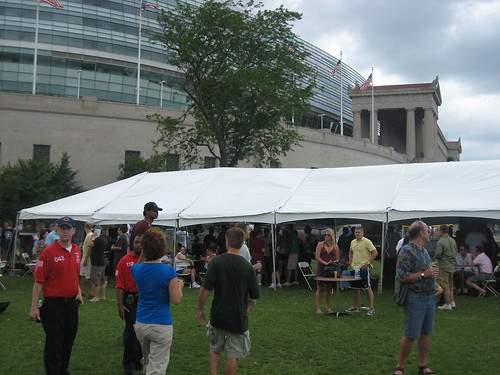
So needless to say, Alefest Chicago trucked into town on Saturday and I partook in the festivities along with some jolly companions (thanks to Annie for unwittingly providing a picture!). For a pittance of monetary input, we received the joy of sampling 20 potions from over 50 breweries worldwide. Let it be known that we went expecting small "tastings" and ended up getting about 1/2 a pint per tasting. Considering some of the belgian and framboise selections topped 10% alcohol and the tendency of some volunteers to forget taking tickets, 20 was streeeeeeeeeeeeetching it. I will proudly say that although I didn't finish the full tastings towards the end, I did indeed sample 20 beers. Actually 18, because I revisited my two favorites.

The fest took place on the grass directly outside the Chicago Bears' Soldier Field. My scheming to clandestinely enter the stadium either via scaling the walls or tunnelling underneath became more elaborate and idiotic as time elapsed. Sadly, these brilliant ideas did not come to fruition. Meanwhile, we endured some mugginess with an occasional rain and made the most of the stupendous libations flowing freely.

So let me quickly dispense with the beer-related criticism: One, I simply don't like pilsners. The aftertaste will never agree with me and I find them pungent. I've tried, maybe for the last time. Two, wheat beers are hit or miss for me. I love a good hefeweisen as much as the next summer reveler (think Widmer Brothers in Portland), but alot of wheat beers bear hints of Belgian white ales...which brings me to my third, and last, criticism. I'm not a fan of most Belgian whites. Again, there are exceptions like the widely distributed Blue Moon Belgian White. Add an orange slice to that beer and I'm in heaven. But that's the exception, unfortunately.

Okay, enough of the bad stuff, let's get to the good stuff...which was roughly 90% of the tastings. I'm going to list off my five favorites, counting towards the cream of the crop:

5) Samuel Smith's Pale Ale (Yorkshire, England): I liked the nuttiness and chocolatey flavor of this moderately dark ale. SS's brown is a favorite of mine, and you could taste the aroma of the brewery pervading their other selections. For me, that's a big winner.
4) St. Peter's Cream Stout (somewhere old, England): This will be a great winter selection. Creamy's the word with a full, lasting flavor.
3) Podkovan Dark Lager (Czech Republic): I liked this beer because it tasted like a delicious brown ale, but finished lighter.
2) Floris Apple (Belgium): I was surprised by this. A lambic brew akin to a cider. Fruity, light, and dry on the finish. A tiny bit of carbonation washes it down perfectly. So refreshing and not too sweet.
1) Breckenridge Brewery Vanilla Porter (Breckenridge, Colorado): I love vanilla for its simplicity and its rich tones, so when crafted into a smooth, delicious porter I was in heaven. This was hands down my favorite discovery.

If I would enhance this joyous experience in any way, I'd encourage some volunteers to learn more about the samples they poured. Many tables had representatives from the breweries or really knowledgeable volunteers, which was great. But there were a few instances where reading the bottle offered more information than the server. Also, they might want to beef up the food selections in order to keep the drinking merry and appease the hungry stomachs. All things considered, however, they did a phenomenal job with Alefest Chicago version 2.0 and I can't wait to upgrade a year from now!

Cheers to you, Alefest.

7.13.2008

Rachmaninoff at Ravinia

There are a few professions I observe where, for a split second, it seems there is no comparable outlet for the myriad intellectual and emotional charges surging inside our bodies. When you see a person at the peak of that profession those feelings multiply. When you have a moment, kindly add ‘pianist’ to this short list of unrequited professional loves.

A certain someone I know harbors a questionably-healthy obsession for Rachmaninoff’s 3rd Piano Concerto. Therefore, when word surfaced that the Chicago Symphony Orchestra (CSO), along with a world reknown Russian pianist, Denis Matsuev, would be performing this number at the outdoor music venue Ravinia, nothing short of Lake Michigan drying up would stop us from attending.

CSO performed two other Rachmaninoff pieces without a featured piano part beforehand, which were both spectacular. That gave us a chance to appreciate the violin and cellos (among others) before the pianist absolutely dominated the show. After a brief intermission, Matsuev took center stage. As a bit of background, the 3rd Piano Concerto has driven accomplished pianists mad with its technical difficulty. Supposedly, only a handful of people on earth can complete a flawless performance and imbue the piece with all the nuances it requires.

Luckily, we stumbled upon one of these living legends. Matsuev, himself, evoked thoughts of a (relatively speaking) attractive Frankenstein. But that is neither here nor there. Well, it might be here a bit. Standing over 6 feet tall and fairly well-built with blocky shoulders and face, he almost made the huge piano look small. Matsuev exhibited a stage flair while playing, but it didn’t seem fabricated. The concerto was so demanding that at points he would drop one of his arms to the side for a brief rest and continue on with the other. Some moments I honestly thought the keyboard would crack under his relentless, but precise, hammering only to find respite a moment later in a soft, feather-light section demanding utmost delicacy. Within a nanosecond he could switch modes seamlessly. Throughout it all, the haunting melody of the concerto spun the threads together. You could physically see Matsuev pouring himself into the piece that lasted roughly 30 minutes and upon finishing it, he burst from the bench and embraced the orchestra conductor. We were positioned to the side of the stage near the front so I had a good view of Matsuev as he strode from the stage. His face looked exhalted and beaming.

Without exaggeration, I can say that was the most moving musical performance I’ve ever witnessed. Also, it surpassed Tim Reynolds’ solo guitar as the most technically challenging show I’ve witnessed at such close range.

Aside from the music, the venue itself made memories. Ravinia consists of the covered orchestra seating (our seats) that is, nevertheless, still open to the elements for 270degrees. Outside this orchestra area, large grassy swaths invite people to bring food and wine and enjoy the music from loudspeakers scattered throughout the grounds. From what I saw, these seats don’t offer a view of the stage, but they also only cost $10. Pretty sweet deal…..barring bad weather.

Unfortunately, bad weather came. And it came. And it came.

Thunderstorms swept through the area throughout the day, but a relative calm pervaded before the start of the show. We went up and met with some friends preparing their grassy perch just prior to the show but, alas, the rains returned. The sky was unforgettable: a solid bank of incredibly dark clouds came roaring in from the west bringing the storms with it. I’m pretty sure the four horsemen galloped on their steeds amidst that turmoil. K and I scrambled for cover down below and left our poor friends to fend for themselves. As it turns out, they found refuge under a covered area in one of the food/drink buildings and managed to make the most of the show. That does go to illustrate the dangers, however, of the grassy seats.

Anyways, the storms ripped and roared throughout the show. There were moments when the orchestra mounted a charge with drums banging, horns blowing, gongs ringing when, meanwhile, lightening blazed through the sky and deafening thunder followed shortly thereafter. All in all, mother nature choreographed herself impressively with the music.

7.10.2008

Amazing

An incredible visual trip inside the body. Even cool for non-sciency people. I promise.
(Thanks to Jason's slacker friend for this)


Coolest Animation Ever - Inside your body - Watch more free videos


7.07.2008

A dip

Nothing short of a revelation dawned upon me last week: you can swim in Lake Michigan along the Chicago shoreline. Call it absurd (it is) that it took me 15 months to grasp this fact, but it made it no less exciting. Tonight, after babbling a week straight about intending to do so, I finally swam in Lake Michigan.

It was so easy. I put on my running shoes, grabbed an old towel, and took my apartment keys. That's it. In the hot and slightly humid early-evening sunlight, I ran down to the lake shore. There are two popular sandy beaches within a mile of my apartment, Fullerton and North Ave, so I picked a less congested spot between them. Although asphalt and concrete replaced sand, I could jump off a 5 foot ledge and get a real plunge into the lake.

I run along that shoreline multiple times each week, but I erected a mental barrier of non-possibility regarding swimming. Summer appetites, however, usurp caution so I started asking around. As it turns out, the water is tested a minimum of 5 times each week for safety conditions. Info is available here. Although unhealthy conditions do arise a couple times each year, the lake is almost always suitable for swimming and you can check online for updated status.

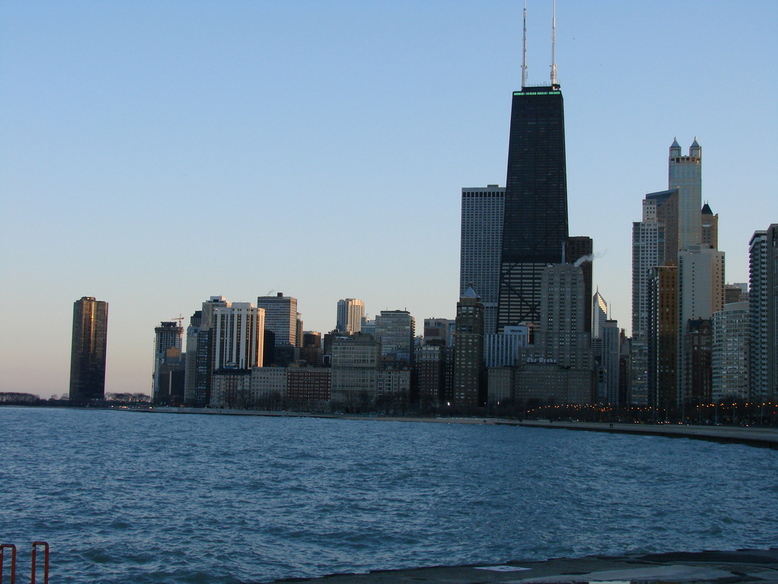
So that's all I needed to know. I hurled myself into the cold waters of Lake Michigan and let my body adjust to the temperature. Like Priest Lake in Idaho, after you get past the initial rush of icy chill, the water feels supremely refreshing. The high rise condos lining Lake Shore Drive started to shield the dropping sun, but I managed to find a 100 foot swath between buildings where I had all the sunlight I ever needed. There, in my little gap of heaven, I swam towards the John Hancock Building towering a mile south, but it looked like I could reach out and grab it (I swam in the bit of water just to the right of this photo). It was a surreal feeling to glide through that water with the Magnificent Mile so close, the runners and bikers and rollerbladers zooming along the lake path, and a pair of tennis shoes and a towel waiting for me up the ladder.

Ahh, summer in Chicago.

6.30.2008

EuroCup '08

Along with the other 6.6 billion humans on earth, I watched the EuroCup soccer final between Spain and Germany (congrats to Spain!). Before the final, I managed to catch select games throughout the tournament. It struck me during the competition, as it strikes me every World Cup, that these international soccer matches surpass all other sporting events for viewer satisfaction.

One important explanation is the nature of soccer, itself. A soccer match plays two 45-minute halves, followed by extra periods or shootouts in the case of ties. Barring a particularly brutal injury or penalty, play essentially never stops throughout those 45 minutes. Whereas commercials, timeouts, pauses between pitches, or huddles slow other sporting events, the intensity remains high and constant throughout a good match. This also demands that soccer players exhibit not only quick-burst speed, but also formidable endurance. I am drawn to that well-rounded conditioning.

Furthermore, soccer requires relatively few accoutrements. Players wear cleats and shin guards—goalies wear gloves—but no other padding, protection, or tools are allowed. To me, there’s something elemental and fundamentally satisfying about that. The simplicity of the sport seems to focus your attention on the athleticism and the strategy without distraction. Also, if a ball of any kind can be found, any impoverished person throughout the globe can setup makeshift goalposts with shirts and play soccer. I love the inclusiveness of the sport.

But those explanations apply to any soccer match. What distinguishes international play is the rarity of so many people passionately uniting under a common, positive cause. I guarantee you that the Basques, Catalans, and Galicians never align themselves with the bulk of Spain as they do during an international soccer match. The 45million Spaniards would have married off their daughters in a heartbeat to rival ethnic groups yesterday evening! Although I always fear overzealous nationalism, in some ways, those drives can minimize internecine and interminable strife, if only momentarily. Now that’s rare. Watching that match and seeing images of Madrid, Barcelona, Berlin, and Munich, you honestly believed those cities were on the verge of erupting. The majority of that energy was positive. Compare, instead, other huge gatherings of similar energy, and you likely pinpoint a protest. These matches truly do supply something incredible in a uniquely positive light.

In general, I love all kinds of sports. If, however, an evil genie came and stripped all other competitions from me except one, I would choose the World Cup.

6.27.2008

I Pee Ale

India Pale Ale, to be exact (I wrote this post just so I could use that title, followed by that line).

But it’s true. An important development has transpired over the last 1 ½ months. Heretofore, I’ve always found IPAs too bitter. However, since combining a Lagunitas IPA with Sonoma cuisine and discovering true euphoria, nothing less complex can satisfy right now.

It’s nothing novel to enter a new stage of preferences. I spent October ’07 through April ’08 salivating non-stop over New Belgium’s 1554, which will undoubtedly remain among my favorites. This latest stage, however, is a leap compared to historical trends. Although not a connoisseur by any means, I am a beer lover and many trysts litter my past (amber ales, brown ales, stouts, oatmeal stouts, lagers, hefeweizens, etc.). For all their character, none of these carried themselves with the sassiness of an IPA. Is this my mid-beer-drinking life crisis? Will I return to the past, mellow favorites after IPAs run their comparatively-flashy course?

All signs point to yes and no. Yes, as in, “Duh, Phil. IPA’s don’t mesh well with lots of foods and, just as moods shift and revisit themselves, so too do beer tastes.” No, in that my palette seems to have taken a seismic shift towards accommodating—and craving—more adventurous flavors. Coincidentally, my food tastes seem to be tracing a parallel course. All I can do is credit Sonoma with making it a lot harder to appreciate a $6 burrito and a Pabst.

Now we all know harder does not mean impossible. Nor, even, necessarily difficult, in an absolute sense. Just harder.

6.25.2008

Fantas-y-tic

Chockronial Salamandus de Rosenstern bestowed upon me, a naïve peasant, George R.R. Martin’s (let’s be cool; let’s call him GRRM) fantasy series, A Song of Ice and Fire. I just finished the first book, A Game of Thrones. Here’s a couple thoughts on why this book rocked not only my world, but my solar system, too:

-GRRM includes a dauntingly large cast of characters in this first book. Furthermore, any author would impress with the number of characters alive. Martin, however, tops himself by referencing countless detailed legends of past heroes and relatives. Based on what I’ve heard of the subsequent books, these character threads—even those seemingly insignificant—continue. In a desirable twist of irony, this lends a sense of verisimilitude to his fantasy world.

-In a similar vein, rarely have I read an author who details clothing and related accoutrements without driving me comatose. I guess the pseudo-Middle Ages context of the story makes these details enticing. Examples include the broach fastening a cape, the rippled pattern of a princess’ dress, the velvet robes of a eunuch, or the bronze mold of a warrior’s helm.

-My just-barely-second favorite part of the book is GRRM’s willingness to treat primary characters, and notably, likeable characters with brutality. A head rolled in this book that I never anticipated losing through the entirety of the series. Some don’t die; they’re simply crippled, mutilated, or banished. It requires an incredible amount of time and imaginative force to develop a prominent character and your readers would start to develop an affinity for them. You sacrifice so much by severing a character's role, but GRRM understands that tragedy is gripping and elevates the fabric of a story. That’s when you know these books aren’t for the faint of heart, but they are for someone who wants an intense experience.

-Probably my favorite element of this book—and I think this might be what attracts his most ardent fans who came many years before me—is the human complexity. In other words, the characters become so nuanced that, unlike the preponderance of fantasy novels (atleast those I’ve read), it’s sometimes difficult to establish a moral hierarchy. GRRM accomplishes this partly through the narrative itself. Each chapter’s content comes from the perspective of a main character. You gather that individual’s thoughts for a short time, but then you’re left to guess until later. While inside someone’s mind, you discover that exterior gallantry need not always equate with fundamental goodness. Characters embody complex motives, some less than noble. Lastly, the perspectives of many of the more intriguing characters remain hidden from the reader. For example, the crafty and calculating members of the King’s counsel are seen only through the eyes of others.

6.19.2008

Miura's bright idea

In honor of T-Hall and his Celtics' triumph, I need to give another shout out. The first, of course, ushered forth after he recommended the greatest restaurant in the western hemisphere. Today, however, I pay tribute for a movie recommendation that the transplanted Montanan provided.

The Man Who Skied Down Everest, documents Japenese skier/adventurer Yuichiro Miura's quest to ascend Mount Everest in 1970 and ski down a considerable portion of the upper mountain. (Warning: although they subtract nothing from the movie, some spoilers follow. You know all you need to know at this point to either be interested or disinterested in seeing the movie.)

Miura departed from Katmandu, Nepal with 800 people lugging supplies on their backs. The team included scientists, photographers, video crews, other skiers, and many hundreds of Nepalese helping to transport heavy equipment and rations up into the mountains. When the team reached the base of Everest, itself, experienced sherpas relieved the Katmandu residents of the remaining supplies, and a much smaller group ascended up into the perilous heights.

In a way, the plan was straighforward: climb to just below 27,000ft (Everest peaks at 29,028ft) to the South Col and ski down 8,000 vertical feet to the Bergschrund—a mammoth crevasse at the bottom of the Lhotse Face that cannot be crossed. Beyond 8,000 vertical feet spelled certain doom. Rescue crews were deployed along the route. Camera crews would capture the descent from the point of departure at 27,000ft, and also from three spots below with telescopic lenses.

Miura correctly calculated that his speed would reach unsustainable levels if unchecked. Therefore, they designed a parachute to deploy behind him as he skied to keep his speeds somewhat manageable. Astronauts, pilots, and sky divers had never deployed parachutes at 27,000ft above sea level, so there was no telling how the parachute might behave. Air is thin at that altitude, hence, many feared the parachute wouldn't catch and Miura would have no check on breakneck speed. Alternatively, imagine the winds that whip across the rooftop of the world. Perhaps, the wind would catch the parachute and literally lift Miura from the mountainside to an elegant, but inescapable death.

The climb itself proved hazardous and, for a few, fatal. Regardless, Miura persevered and decided to ski. He skied an unfathomable 6,600 vertical feet down Everest in 2minutes and 20seconds, and that was with a parachute! He slid an additional 1320 vertical feet to just above the crevasse. Furthermore, the slope angled at ~45degrees, which any recreational skier knows is treacherous in icy conditions. Imagine trying to control a rickety pair of skis under these conditions on Everest's wind-battered icy ramparts that laugh at the mere thought of a grooming machine?

This dramatic feat inevitably begs the question: was it worth it? A team of Japanese scientists participated in this adventure and managed to collect data ranging from physiological performance under alpine duress, geophysical measurements of Everest, and, of course, the behavior of a parachute at 27,000ft. They surely gathered some important data. The financial cost (3.5million dollars) far outpaced any immediate scientific/medical benefits, however. Furthermore, although no one forced them to participate, a number of Nepalese sherpas lost their lives when a monster ice field caved-in. All this for what?

Well, all this for the purpose of pushing human limitations and eking the most out of our fleeting existence on earth. In our own small ways, we each do this everyday. I can pinpoint people who don’t live out some measure of this philosophy; these people remain unfulfilled and unhappy. The impositions we place on ourselves regarding risk and reward are largely arbitrary. There’s no absolute barometer for knowing when your risk is justified or not. Only individuals can answer this question for themselves. No resident of Katmandu, no sherpa, no scientist, no skier, no photographer participated in this quest against their free will. The only element that gives me pause is when I consider those, including Miura, who had young children at the time. You assume additional obligations as a parent and have a responsibility to those you bring into this world who cannot yet fend for themselves. Judging by Miura’s thoughtful journal excerpts read (translated into English) throughout the movie, I trust Miura understood and cherished his obligations and settled this issue with his family (and himself) beforehand. I don’t think it’s a risk I could take as a young father, but my tenets are only my own, and I do understand the elation and importance of conquering what seems impossible. So, yes, with qualifications, I certainly think it is worthwhile.

In 1985, Miura claimed another remarkable feat: he had skied the tallest mountains on all 7 continents. To add to his already firmly established legend, Miura summited Everest in 2003 to become the oldest person to accomplish this at 70 years old. That's not all. This year, 2008, Miura set about to reclaim this coveted record which had been surpassed by a 71 year old a couple years back. Although his accomplishment was slightly eclipsed by a 76 year old Nepalese climber who summited 2 days beforehand, Miura did, indeed, summit Everest again last month. He is 75 years old and likely plotting his next challenge.

I've decided upon a little project: watch all the winners of Documentary Film for the Academy Awards.